Our class seems to love to take shots at Benjamin Franklin. We have called him arrogant, egocentric, pompous, but I don’t think that is a fair assessment to make from an autobiography or that we should compare it to the works by Irving. Franklin may have had a bit of an ego to him, but it is unfair to say that from his autobiography. It is only human nature to portray oneself in the best possible light, I don’t think it anything special to Franklin. Even those who would do play down their accomplishments are most likely doing so to take the persona of a modest person (or else why would they have written an autobiography).
Irving takes a persona that lets him throw stones from the outside. He is attacking the superstitions help the puritans and other Americans and turning it into something fun and exciting. Irving’s personal dignity is not at stake in his writing, except perhaps the quality, unlike Franklin. Also this book was for his son, and from my view of most historical father-son relationships, the father will present himself in a larger than life type of manner, perhaps to feel superior, perhaps to inspire his son to greater heights. I don’t know, but here is a touching moment of Franklin with his son.
Showing posts with label Ben Franklin. Show all posts
Showing posts with label Ben Franklin. Show all posts
Wednesday, February 24, 2010

Tuesday, February 23, 2010
FRANKLIN AND IRVING


The persona that Benjamin Franklin creates in his autobiography is one of almost sincere arrogance. He gives of a type of pride and confidence about himself that others may admire, while others may find it annoying. Franklin is an individual and believes in individual success, in which he set up principals and ideals for himself. Through his believes he writes to his son explaining how he became successful, and even lays out some guidelines that may help his son become successful. This guideline is called the thirteen virtues, which are temperance, silence, order, resolution, frugality, industry, sincerity, justice, moderation, cleanness, tranquility, chastity and humility. Franklin was set on attempting to be the “perfect man.”As oppose to the persona that Washington Irving gives off for the characters in “Rip Van Winkle” and The Legend of Sleepy Hollow. These characters are much less prideful than Franklin. In “Rip Van Winkle,” Rip is a very nonchalant guy. He seems to live life by the day instead of having a plan for himself or his family, which is the total opposite of Franklin. Unlike Franklin, Rip seemed to be lazy in certain aspects of his life. Franklin’s character was formed by difficult task and willpower. Although Rip was a seemed to be unconcerned at times, he did serve as a purpose for Irving. This purpose may have been to let us know that we are nothing without the past. When Rip came back from his mysterious disappearance, he still could recollect aspects of the past. For that reason he was seen as a sort of historian to the new village. So in a sense Franklin and Irving’s characters may not be all that different, they all have a sort of mystery about them and serve as ally for the past.
Franklin and Irving Do It Their Way

Ben Franklin's persona in his autobiography is that of a confident, well educated, and systematic man. When compared to Washington Irving's fictional character Ichabod Crane from The Legend of Sleepy Hollow, we begin to find similarities between these men. They are both intellectuals (Crane is a school teacher) and lady killers as well. Franklin creates a system for success which helps him to become a self-made, wealthy, and important individual, but Crane aims to use his intellect to win over a young girl for her father's wealth. Thus, both of these men act for their own personal gain of wealth and power. A major difference between these men is the rational "from the ground on up" ethic of Franklin and the "one big plan" of the fictional Crane."

In Irving's Rip Van Winkle, we find a much more giving character that is much less interested in the highlights of society than our other two characters. Van Winkle is somewhat of an adult version of Huck Finn. He only wants to be left alone to do what he pleases. Winkle also enjoys helping others with their work, but does not enjoy doing any work for himself. Here, Winkle further differs from Franklin and Crane who act only for themselves.

In Irving's Rip Van Winkle, we find a much more giving character that is much less interested in the highlights of society than our other two characters. Van Winkle is somewhat of an adult version of Huck Finn. He only wants to be left alone to do what he pleases. Winkle also enjoys helping others with their work, but does not enjoy doing any work for himself. Here, Winkle further differs from Franklin and Crane who act only for themselves.
These chara
 cters also provide similar and different views of their world. Franklin's world is very intent on rules, which we can recognize from his father assigning him to the printing business like his brothers and then having to present his writings under a separate identity. This is of course a much more real world in Franklin than in Irving's fantasies. Although Rip Van Winkle tells a tale of fiction, it also displays a worldly change in America from before the Revolutionary War to after.
Thursday, February 18, 2010
The Legitimacy of Persona

The personae Benjamin Franklin and Washington Irving use in their works allow the authors to write without fear of dodgy repercussions. In the case of Franklin, he appears as a cosmopolitan, questioning individual seeking personal betterment. He is the perfect model for his son (he is moral and an intellectual), which keeps the reader from noticing Franklin’s actual personality of an egotistical chauvinist. Franklin’s persona pleases his audience’s sensibilities and, therefore, gives him credibility as a decent self-made man.

Likewise, the persona of Diedrich Knickerbocker that Washington Irving creates legitimizes the stories of “Rip Van Winkle” and “The Legend of Sleep Hollow.” Knickerbocker is a humanist interested in preserving the Dutch culture. He seems to be a simple man well liked by all; Knickerbocker is even known to have an honest reputation due to his “scrupulous accuracy.” However, this accuracy is also undercut due to his fantastical descriptions that often add humor and the supernatural events that occur in the two stories. Franklin’s persona is also undercut by his constant mentioning of vanity and humility, such as the vain act of writing an autobiography.
Both authors use a persona to create an authentic, human figure as compared to crediting God and the devil like the Puritans did in their works. The personae help mark the shift from other-worldly to “earth based practicality” in terms of legitimacy. However, Franklin’s persona is much closer related to Puritan ideology because he supposedly promotes virtues. Irving’s persona merely helps promote supernatural stories.
Thursday, February 11, 2010
Ben Franklin: You're so Vain

The most striking aspect of what makes Ben Franklin different from previous Puritan authors is his overwhelming sense of vanity. Ben’s purpose for writing the autobiography was to show his son the model life, his life. He later expands this intent for all of mankind in Part II with the introduction of two highly praiseworthy letters. Ben is the quintessential illustration of the American dream or the self-made man. If anyone is to succeed in life, then he should follow Ben’s example. Ben is concerned with this world, not the next as the Puritans were. Ben also differs from the Puritans because he alludes that God has nothing to do with his ascent. It is only through hard work that he was able to achieve success; for instance, he started when he was a young child by attempting to improve his mind through extensive reading and debate with his friend Collins. Ben does not mention his beliefs on God until much later in the text. He admits that he does not even attend church anymore. As a deist, he believes that God does not directly interfere in the lives of his creation. He is the closest thing in the 18th century to an atheist.
On another note, Ben’s writing style reflects his journalistic tendencies. He is very concise and to the point, but at the same time includes many anecdotes. The Puritans tend to be long-winded while being descriptive.
On another note, Ben’s writing style reflects his journalistic tendencies. He is very concise and to the point, but at the same time includes many anecdotes. The Puritans tend to be long-winded while being descriptive.
The Inventor of The American Dream
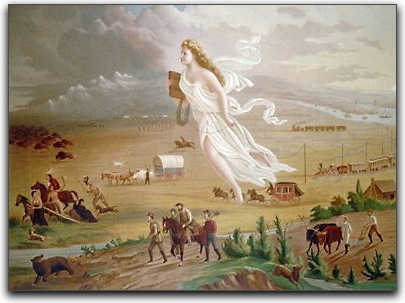
Benjamin Franklin's autobiography tells the story of a poor young man who becomes a pivotal figure in the creation of the American Nation. He goes through his young boyhood as a candle maker to a man who composes a set of virtues in which all men can follow to achieve the American Dream. In a way, these Thirteen Virtues in which he describes is the first stepping stone in the building of the American Dream. This "dream" is a belief that anyone, despite their social status or monetary situation can achieve greatness. Benjamin Franklin's autobiography is the first written exhibition of this dream being achieved. It is with this autobiography that leads Americans to their belief in manifest destiny in the Westward Expansion. The early Americans believed, through their president's example, that in America anyone can achieve greatness and the Western Frontier was the place to do this. In all, Benjamin Franklin's autobiography is one of the first recorded examples of someone achieving the American Dream in early America and this book sets a guideline for the rest of Americans with the Thirteen Virtues.
This idea of being in control of one's life and lifestyle is completely opposite from the Puritan values that were embraced when first settlers arrived.The Puritan belief was that everyone's life is predestined by God: monetarily and socially. Therefore, the idea that one is able to alter one's life was completely new in America. The fact that the president achieved this provided an example for the rest of the country to follow by. He became the first example of a person achieving the American Dream.
Tuesday, February 9, 2010
Subscribe to:
Posts (Atom)