Cooper's "novel displays the American dream turning into the nightmare to which we still awaken" (Weidman, 18).
James Fenimore Cooper might have become a writer, or novelist, on a whim, but he was a “stranger” and therefore quite the paradox inherently and emotionally. Born into the ideal “American Dream” that his father, William Cooper, symbolized and implicitly created, James was constantly conflicted politically and morally by his naturalistic beliefs and a late desire to fill his father’s large American shoes.
William Cooper recalled in his Guide in the Wilderness: “I found fault with their fences… I had nothing better to do than to conform; and am every day more convinced, that wherever men’s minds are uncontrolled they will in a short time discover what is for their interest better than strangers can instruct them.” W. Cooper founded Cooperstown, New York, he was elected first Judge of the Court of the Common Pleas, he served two terms in Congress, and he developed an extremely wealthy estate. J. F. Cooper found himself in a dark shadow to which he proclaimed that “one fact is beyond dispute, I am not with my own country – the void between us is immense,” perhaps alluding to the difference between him and his father as well as that between him and his nation.
The gaping oppositional forces around him are, for J.F. Cooper, morally unanchored and through his words he is able to piece together an irreparable history while both standing for the pre-colonial past intertwined with the natural law of the wilderness and the inevitability of civilized men’s egotistically driven conquest. In his novels, his desire to resolve his conflicting situation manifests in the union of Cora and Uncas, symbolizing the melting of cultures and the “mingling of races.”
J.F Cooper struggled in public attention becoming much disliked because of his texts and every attempt to follow in his father’s path was defeated. He tried to repair his reputation, but it was too little too late. He says in the last years of his life in reflection of public abuse, “Bodies of men are proverbially heartless. They commit injustice without reflection, and vindicate their abuses without remorse. He who is crushed by the masses themselves must look beyond the limits of his early being for consolation and support. The wrongs committed by democracies are of the most cruel character.”
Regardless of this scrutiny, he considered himself a historian with an obligation to record truth. His novels reflect a deeper personal truth in which “Natty is portrayed [-] as a man whose choices have aligned him with those who are to be exterminated. The mediating position of one who cherishes ‘white man’s gifts’ and the red men’s style of life is futureless”
Works Cited
Weidman, Bette S., “White Men’s Red Man: A Penitential Reading of Four American Novels” Modern Language Studies, Vol. 4, No. 2 (Autumn, 1974) pp. 14-26.
Zoellner, Robert H., “Fenimore Cooper: Alienated American” American Quarterly, Vol. 13, No. 1 (Spring, 1961) pp. 55-66.
Showing posts with label American Dream. Show all posts
Showing posts with label American Dream. Show all posts
Friday, March 5, 2010

Thursday, February 11, 2010
The Inventor of The American Dream
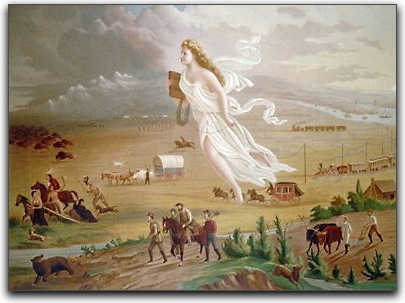
Benjamin Franklin's autobiography tells the story of a poor young man who becomes a pivotal figure in the creation of the American Nation. He goes through his young boyhood as a candle maker to a man who composes a set of virtues in which all men can follow to achieve the American Dream. In a way, these Thirteen Virtues in which he describes is the first stepping stone in the building of the American Dream. This "dream" is a belief that anyone, despite their social status or monetary situation can achieve greatness. Benjamin Franklin's autobiography is the first written exhibition of this dream being achieved. It is with this autobiography that leads Americans to their belief in manifest destiny in the Westward Expansion. The early Americans believed, through their president's example, that in America anyone can achieve greatness and the Western Frontier was the place to do this. In all, Benjamin Franklin's autobiography is one of the first recorded examples of someone achieving the American Dream in early America and this book sets a guideline for the rest of Americans with the Thirteen Virtues.
This idea of being in control of one's life and lifestyle is completely opposite from the Puritan values that were embraced when first settlers arrived.The Puritan belief was that everyone's life is predestined by God: monetarily and socially. Therefore, the idea that one is able to alter one's life was completely new in America. The fact that the president achieved this provided an example for the rest of the country to follow by. He became the first example of a person achieving the American Dream.
Subscribe to:
Posts (Atom)